




IELTS Speaking Essentials
25 Game-Changing Phrases

A Forward From Haitham, The Founder of Learn Hive & The Language Sentinel Dispatch
Over the years, I’ve been asked—more times than I can count—to help students “just get a 6.5 or 7” in IELTS at the very last minute. Many are hoping for a miracle. The truth? That’s often wishful thinking if grammar hasn’t been solidly built beforehand.
In my time working overseas, particularly during my years of corporate testing for a well-known international language school, I assessed hundreds of candidates applying for roles at large multinational companies like Arçelik, Ford, Nestlé, PricewaterhouseCoopers (PWC), Pfizer, Sanofi, and VW. Many of these candidates were under intense pressure—sometimes their entire job, scholarship, or future university placement in a country like Canada, Germany, the Netherlands, or the UK depended on that test score.
I remember stepping in for the speaking portion of the exam. Candidates would launch into a rehearsed monologue, thinking, “I nailed it!” I let them finish. I never interrupted. But then, after their memorized performance, I would gently begin the real assessment:
“What’s your name?”
That one question was enough to catch them off guard, some were even stumped, I would even daresay bewildered.
Then I’d ask:
“Where do you work?”
“What did you do yesterday?”
Simple questions. Tthat’s where the real test began.
You’d be amazed how often simple grammar—not complex vocabulary—was the biggest hurdle. Many students answered with strangely convoluted responses. Why? Because they were expecting fancy questions and forgot to master the basics. The IELTS speaking test is not just a vocabulary challenge—it’s a grammar test in disguise. Every question is an invitation to demonstrate control over tense, syntax, and clarity.
Yes, memorizing phrases can help. But you must know how to deploy them with accuracy and in the correct context. You don’t need to sound perfect—but you do need to understand the question, and mirror its structure in your response. That’s how scoring works.
This post isn’t about tricks. It’s about giving you tools. Below are 25 carefully chosen phrases that will elevate your fluency—but they work best when paired with grammar awareness and strategic thinking.
Read on, and let’s get you moving toward your target score—with confidence and control.
25 Power Phrases to Supercharge Your IELTS Speaking Score Real Vocabulary. Real Band Boosts.
From Haitham’s Creative Desk at The Language Sentinel Dispatch — only at Learn-Hive.com
So you’ve memorized all the IELTS question types. You’ve rehearsed your cue card responses. But what about your vocabulary?
In the IELTS Speaking exam, high-level vocabulary isn’t just about throwing in “big words.” It’s about clarity, precision, and flexibility—words that help you express yourself naturally while impressing the examiner with fluency and range.
Whether you’re tackling Part 1 small talk, a Part 2 long-turn, or analytical questions in Part 3, here are 25 powerful phrases and expressions that will give your answers more punch, polish, and power.
PART 1: Everyday Topics (Hobbies, Work, Free Time)
1.“I’m quite partial to…”
➡ Meaning: I like
➡ Grammar Tip: Followed by a gerund (verb + -ing)
➡ Example: I’m quite partial to baking on weekends—it helps me unwind after a hectic week.
2.“It’s a real game-changer for me.”
➡ Meaning: Something impactful or transformative
➡ Grammar Tip: Often used with present perfect or past perfect
➡ Example: Switching to remote work has been a real game-changer in terms of work-life balance.
3.“It’s not really my cup of tea.”
➡ Meaning: Not something I enjoy
➡ To be honest, high-energy social events aren’t really my cup of tea—I tend to prefer more low-key environments like dinner with friends or a quiet evening at home.
4.“I make a point of…”
➡ Meaning: I intentionally do this regularly
➡ Grammar Tip: Always followed by a gerund
➡ Example: I make a point of reading the Language Sentinel Dispatch on Learn-Hive.com every morning to stay informed.
5.“It gives me a sense of accomplishment.”
➡ Use it when talking about achievements or goals
➡ Grammar Tip: Can also be used in present perfect or past perfect
➡ Example: Finishing a challenging puzzle always gives me a sense of accomplishment.
➡ Alternate Example: That project had given me a real sense of accomplishment.
PART 2: Cue Cards (Describe a Person, Place, Memory, Event)
6.“What really stood out was…”
➡ Use this to emphasize a detail
➡ Example: What really stood out was the kindness of the locals—we felt right at home.
7.“It left a lasting impression on me.”
➡ Use this when describing meaningful memories
➡ Example: The ceremony left a lasting impression on me; I’d never seen anything so moving.
8.“It was a once-in-a-lifetime experience.”
➡ Perfect for describing travel or events
➡ Example: Visiting the ancient temples of Kyoto was truly a once-in-a-lifetime experience.
9.“I was blown away by…”
➡ Use this to show strong emotion or reaction
➡ Example: I was blown away by the view from the summit—it was breathtaking.
10.“To this day, I still remember…”
➡ For lasting memories or impressions
➡ Example: To this day, I still remember how nervous I felt before giving that speech.
PART 3: Analytical or Opinion-Based Questions
11.“From my perspective…”
➡ More academic than ‘I think’
- Example: From my perspective, governments have a crucial role in supporting small businesses.
- Similar phrases: “How I see this”, “from my vantage point”
12.“There’s no denying that…”
➡ Strong opening for an argument
➡ Example: There’s no denying that climate change is already affecting global agriculture.
13.“It’s a double-edged sword.”
➡ When something has both pros and cons
➡ Example: Social media is a double-edged sword—it connects people but also fuels comparison.
14.“The benefits outweigh the drawbacks.”
➡ Ideal for compare/contrast responses
➡ Example: In my opinion, the benefits of working abroad outweigh the drawbacks.
15.“It boils down to…”
➡ To summarize the core idea
➡ Example: It all boils down to prioritizing mental health in the workplace.
Flexible Phrases for All Parts
16.“At the end of the day…”
➡ To conclude or summarize simply
➡ Example: At the end of the day, what matters most is spending time with loved ones.
17.“I tend to…”
➡ A great hedge phrase showing nuance
➡ Example: I tend to overthink things, especially when making big decisions.
18.“I wouldn’t say I’m an expert, but…”
➡ Shows modesty while introducing knowledge
➡ Example: I wouldn’t say I’m an expert, but I do follow the tech industry quite closely.
19.“That being said…”
➡ Perfect for introducing contrast
➡ Example: I love big cities. That being said, I do miss nature sometimes.
20.“If I had to choose one…”
➡ Great for hypothetical cue cards or preferences
➡ Example: If I had to choose one book that changed my life, it would be…
Bonus: Band 8+ Vocabulary You Can Drop Anywhere
21.Unwind (relax)
22.Overwhelming (very strong or intense)
23.Underrated (not appreciated enough)
24.Tedious (boring or repetitive)
25.Pivotal (extremely important)
Want to Sound This Natural?
This is what we do at Learn Hive. In our IELTS programs, you don’t just memorize words—you learn to own them.
Our students learn to:
•Speak without “translating in their head”
•Use real-world vocabulary naturally
•Receive detailed feedback on tone, fluency, and phrasing
Includes Hive Speaking Studio sessions, recorded feedback, and personal coaching.
Final Tip
Don’t memorize — personalize.
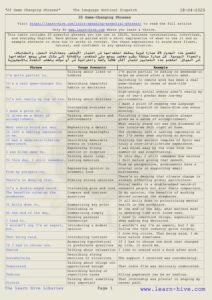
You can download the PDF Version of the above here by clicking on this text.
You don’t need to sound like a thesaurus. You need to sound clear, natural, and confident under pressure.
Now you’ve got 25 power phrases in your toolbox. Use them wisely—and don’t forget to smile when you speak.
What’s your favorite IELTS phrase from this list? Let us know in the comments.
Ready to train like a Band 8 speaker?
Book your free assessment or explore our customized IELTS speaking intensives at Learn-Hive.com.